
Organisations are moving away from passwords and legacy authentication methods in favour of certificate‑based authentication, Zero Trust architectures, and SASE (Secure Access Service Edge) platforms. As networks become more distributed and multi‑vendor environments become the norm, businesses need an identity and certificate solution that works seamlessly across different technologies. This is where Soliton OneGate stands out.
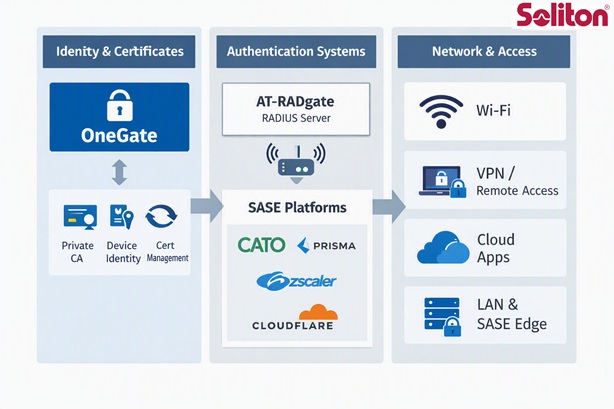
OneGate is more than a cloud‑based certificate service. It is a fully managed private Certificate Authority (CA) designed to integrate with a wide range of authentication systems, network access solutions, and modern SASE platforms. Whether paired with AT‑RADgate for RADIUS authentication or used alongside Cato Networks, Palo Alto Prisma Access, Zscaler, or Cloudflare One, OneGate provides the strong device identity foundation required for secure, passwordless access.
OneGate as a Private CA: The Foundation of Strong Device Identity
At its core, OneGate delivers what most authentication platforms lack: enterprise‑grade certificate lifecycle management. It issues, distributes, renews, and revokes certificates automatically, binding each certificate to a specific user and device. This creates a strong, tamper‑resistant identity that cannot be phished, guessed, or stolen.
Many network and security vendors support certificate‑based authentication, but very few provide a complete certificate lifecycle. This gap is precisely where OneGate adds value. By acting as the private CA, OneGate enhances any authentication workflow without replacing existing infrastructure.
Integration with AT‑RADgate: Certificate‑Based RADIUS Made Simple
A perfect example of OneGate’s versatility is its integration with Allied Telesis AT‑RADgate. In this model:
- OneGate functions as the private CA, issuing and managing certificates.
- AT‑RADgate acts as the RADIUS server, performing the actual authentication.
- Devices connect automatically using certificates, enabling passwordless Wi‑Fi and wired network access.
This approach modernises traditional RADIUS authentication and aligns it with Zero Trust principles. Organisations gain stronger security, simplified operations, and a seamless user experience, without replacing their existing network infrastructure.
Extending the Model to SASE Platforms: Cato, Prisma, Zscaler, Cloudflare
The same integration pattern used with AT‑RADgate applies perfectly to modern SASE solutions. SASE platforms provide secure access to cloud applications, remote networks, and internal resources, but they often rely on:
- Passwords
- MFA apps
- Browser‑based identity
- Lightweight device posture checks
What they lack is strong, certificate‑based device identity.
By integrating OneGate as the private CA, SASE platforms gain:
- Strong device authentication
- Passwordless access
- Automated certificate lifecycle
- Zero Trust identity binding
- EU‑sovereign PKI for GDPR compliance
This enhances the security posture of SASE deployments without requiring any changes to the SASE platform itself.
Whether it’s Cato Networks, Palo Alto Prisma Access, Zscaler, or Cloudflare One, OneGate can serve as the certificate authority that strengthens device identity and ensures consistent authentication across all access paths.
Why Multi‑Vendor Environments Benefit from OneGate
Modern IT environments are rarely built around a single vendor. Organisations use:
- One vendor for Wi‑Fi
- Another for VPN
- Another for SASE
- Another for identity
- Another for NAC or RADIUS
This diversity creates complexity, especially around authentication and device identity.
OneGate solves this by acting as the central certificate authority across all vendors. The benefits include:
1. Consistent Identity Across All Systems
OneGate ensures every device has a trusted certificate, regardless of which vendor handles the authentication.
2. Passwordless Access Everywhere
Certificates eliminate passwords across Wi‑Fi, VPN, SASE, and internal networks.
3. Zero Trust Alignment
Strong device identity is a core requirement for Zero Trust. OneGate provides it universally.
4. Reduced Operational Overhead
OneGate automates certificate issuance, renewal, and revocation—removing manual workload.
5. Vendor Independence
Organisations can choose the best network, SASE, or security vendor without worrying about identity fragmentation.
OneGate Is the Identity Layer for Modern Zero Trust Networks
As organisations adopt Zero Trust and SASE architectures, the need for strong, certificate‑based device identity becomes critical. OneGate delivers this identity layer with unmatched flexibility, integrating seamlessly with RADIUS servers like AT‑RADgate and cloud‑based SASE platforms such as Cato, Prisma Access, Zscaler, and Cloudflare One.
In a multi‑vendor world, OneGate provides the unified, passwordless, certificate‑driven authentication foundation that modern organisations need:
Secure, Scalable, and Future Proof.