For plant managers, operations leaders, and manufacturing engineers, industrial workforce transformation is no longer a distant concept, it’s arriving alongside smart factories and shifting expectations on the floor. The core tension is clear: roles built around repetition and manual checks are being redesigned around digital skills in manufacturing, data-driven decisions, and fast problem resolution, while staffing and training systems often lag behind. At the same time, human-machine collaboration is becoming the new baseline, raising real questions about trust, safety, accountability, and career paths. Clearer roles, better skill alignment, and a more resilient future of industrial jobs are within reach.
Choose Edge Servers That Keep Smart-Factory AI Real Time
When production teams rely on fast feedback loops with sensors, robotics, and AI, the biggest wins often come from keeping critical computers close to the line. Edge servers make that possible by processing factory data locally, in real time, instead of shipping everything back to a distant cloud or data center. Running analytics on-site cuts latency and bandwidth use, which means quicker decisions for vision and control tasks, and it helps workers collaborate more effectively with automated systems and AI-driven tools because insights and responses arrive when they’re needed.
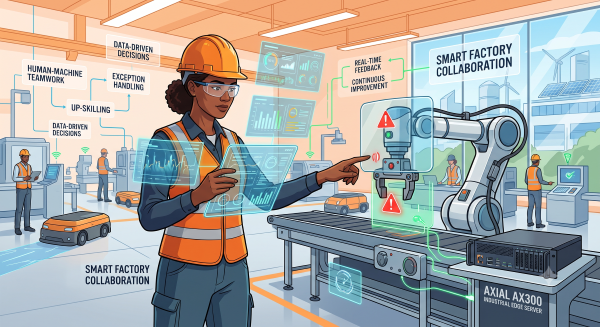
Hardware matters here: the edge needs enough on-premise muscle to handle GPU-accelerated vision and other demanding workloads, alongside storage and expansion headroom for growth. For example, the Axial AX300 rackmount server is a high-performance, scalable industrial rackmount edge server with filtered fan, built for complex workloads in demanding IT and OT environments. With support for Intel Xeon processors, multiple GPUs, and extensive storage and expansion options, it can run advanced analytics, AI workloads, and virtualization at the edge. Its scalable architecture and built-in security features also support deploying powerful on-premise computing right where data is generated.
Understanding How Smart Factory Roles Evolve
In a smart factory, automation rarely “removes” a job in one clean step. It more often rearranges the work, with machines handling repeatable actions while people shift toward oversight, decision-making, and improving the system that runs the line.
This shift is happening at scale: 60% will have tasks significantly modified by AI, which means many titles stay the same while daily responsibilities change. When humans focus on exceptions, quality judgments, and small process tweaks, production stays stable even as technology speeds up.
Think of a modern operator more like an air-traffic controller than a button-pusher. Most of the time things run smoothly, but when a sensor flags a defect or a robot drifts, a person steps in to diagnose and correct the cause. That reality makes upskilling a leadership priority, not a nice-to-have.
Build a 5-Part Reskilling Plan for Human‑Machine Teamwork
Smart factories don’t just “replace tasks”, they reshuffle work toward supervision, exception handling, and continuous improvement. Use this five-part plan to turn that shift into a clear set of employee reskilling programs and daily habits people can actually practice.
- Translate role evolution into a simple skills map: Start by listing the top 10 “new human” moments in your process (alarms, quality escapes, changeovers, downtime triage, tuning setpoints, investigating anomalies). For each, define the human‑machine collaboration skills required: interpreting dashboards, asking good diagnostic questions, safe intervention, and documenting learnings for the next run. Keep it practical by writing “can-do” statements such as “can verify sensor drift using a standard check and escalate with evidence.”
- Run a 30-minute gap check per person (no surprises): Use a quick assessment that mixes observation plus a short scenario: “Robot faults mid-cycle, what do you check first and why?” Score three areas on a 1–4 scale: technical (systems basics), cognitive (troubleshooting/decision-making), and behavioral (communication during escalations). Share results immediately and co-create one priority skill to build in the next two weeks, this is workforce empowerment, not a hidden performance review. A useful north star is that empowered employees perform at the 79th percentile of engagement, so give people real ownership of their plan.
- Target “digital workplace readiness” before advanced tech: Many reskilling efforts stall because basics are shaky. Make sure everyone can confidently use digital work instructions, record structured notes, follow data naming conventions, and practice cyber-safe habits like locking stations and handling credentials correctly. Set a minimum standard such as “complete two digital work orders error-free” or “log three downtime events with clear categories” before moving to analytics or automation tuning.
- Build coached practice into the shift (micro-drills + shadowing): Replace one-off training with 10–15 minute “micro-drills” three times a week: interpret one trend chart, diagnose one simulated fault, or perform a handoff using a standard template. Pair less-experienced workers with a “floor coach” for two changeovers or one full troubleshooting cycle, then debrief using two questions: what signal mattered most, and what would you do differently next time?
- Reinforce with a 60-day cadence and visible wins: Put your upskilling strategies on a calendar: week 1 baseline, weeks 2–7 coached practice, week 8 re-check and role stretch. Track two outcomes that matter to operators and leadership, fewer repeated faults and faster, safer recoveries, then share short stories in team huddles. The momentum is real when the increasing share of the workforce completing training is treated as normal operations, not an extra.
Pick a Flexible IT Learning Path That Fits Shift Work
Once you’ve mapped the skills people need to work confidently alongside automation, the next step is choosing training that employees can realistically complete while staying on the line. Earning an IT degree can be a practical way to build the digital foundation smart factories now rely on, skills like working with data, understanding how software and connected systems interact, and thinking analytically about what’s happening across production. That blend helps workers move beyond repetitive tasks into higher‑value roles where they support day‑to‑day smart‑factory operations, collaborate effectively with advanced technologies, and help keep automated environments running smoothly.
For many working adults, the format matters as much as the content. A distance IT degree program can make it easier to keep a full‑time schedule, especially with rotating shifts, while steadily progressing through coursework designed to strengthen those digital, analytical, and systems‑integration capabilities. As automation spreads, the toughest questions aren’t about whether learning matters, but what it means for job security and opportunity.
Smart Factory Job & Skills FAQs
Q: What happens to my job when automation arrives?
A: Automation usually shifts tasks, not just headcount, especially where quality, safety, and troubleshooting still need people. Many manufacturers are struggling to hire enough talent, with two million manufacturing jobs projected to go unfilled, which makes reskilling a real opportunity. Ask your supervisor which tasks are most likely to change, then choose one adjacent skill to learn first.
Q: How can I keep up with new systems while working full time?
A: Start small with 15 to 30 minutes a day focused on one tool you see on the floor, like dashboards, scanners, or PLC interfaces. Use a simple plan: learn the basics, practice on one real task, then document what you did. Consistency beats cramming.
Q: What skills should I learn first if I’m not “techy”?
A: Prioritize practical digital basics: reading data trends, using troubleshooting checklists, and understanding how a machine hands off to the next step. Then add one targeted skill, such as basic scripting, HMI navigation, or sensor health checks. Choose skills tied to a current pain point like downtime or scrap.
Q: Why does training feel overwhelming, and how do I make it manageable?
A: Many programs fail because they are too broad or too theoretical. Look for focused training sessions that teach one tool and include hands-on practice and a clear credential. If you can, schedule learning right before or after a shift so it becomes routine.
Q: When should I talk to my manager about reskilling or a role change?
A: Bring it up as soon as new equipment, software, or metrics appear, even if the rollout is months away. Ask what roles will support the technology and what proficiency looks like. Then propose a trial, like shadowing maintenance, controls, or quality for one week.
Understanding Smart Factory Roles and Collaboration
Smart factories work when connected tech and connected people move together. Smart factory IoT apps capture signals from machines, industrial data platforms organize those signals, cybersecurity keeps access and changes controlled, and OT-IT integration helps plant systems and business systems share the same reality. That blend creates new job families that sit between trades and tech, such as OT data analyst, automation technician, or edge and IIoT admin.
The glue is cross-functional collaboration, where people with different areas of expertise coordinate around uptime, quality, and safety. It reduces handoff gaps, speeds troubleshooting, and makes learning feel relevant.
Picture a recurring jam on a packaging line. Maintenance stabilizes the actuator, the OT data analyst spots the trigger pattern in timestamps, the edge admin checks device health, and cybersecurity verifies no risky remote change occurred. The fix sticks because everyone sees the same data story. Human-centered tools plus team synergy make success repeatable, so pick one role to redesign and one support to add.
Upgrade Work, Not Just Machines, in the Smart Factory
Smart factories can stall when new platforms arrive faster than people can adapt, leaving collaboration and confidence behind the tech. The way through is a human-centric technology mindset that prioritizes workforce empowerment and tight technology and employee synergy as core smart factory success factors. When that balance is in place, roles become clearer, handoffs get smoother, and digital augmentation benefits show up as safer work and more reliable performance. Smart factories succeed when technology amplifies people, not when people chase technology.